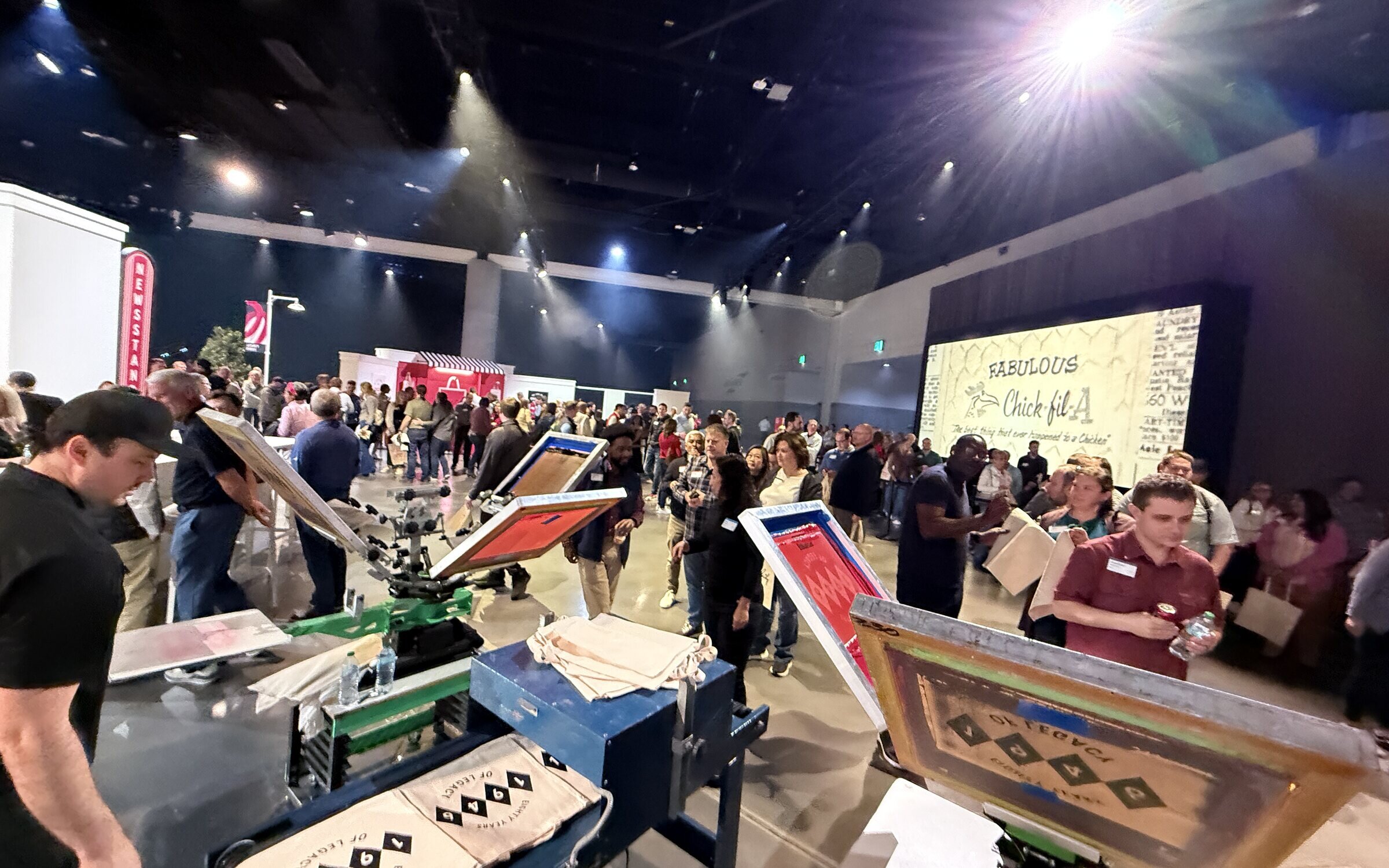
Corporate is the one event type where the number is settled before you plan anything. Registration closes, the list is final, and that certainty changes every decision downstream: you can commit to sizes, pre-produce the bulk of the run, and hold a smaller staffed station for the pieces that gain something from being finished in front of the person receiving them. The risk stops being "will we run out" and becomes "will anyone actually want this", which is a design and item-selection problem rather than a logistics one.
Building a mix around a headcount you already have
With a confirmed list we usually split a program three ways: a core piece everyone receives, a middle tier that has to be chosen or earned, and a short run of something genuinely good for speakers, executives and the event crew. Sizes on the core piece follow a standard curve; the tiers above it get ordered deliberately short, because scarcity does more for how a piece is valued than volume ever does. Caps and light outerwear carry a company mark better than a tee in most offices, and they survive the closet cull that quietly disposes of most conference apparel.
Approvals, sponsor marks and multi-brand lock-ups
These programs live or die on the review cycle, so we work backwards from it: a proof per item and per method, mock-ups showing placement and scale on the actual blank rather than on a flat template, and a locked artwork set before anything is ordered. Multi-brand work is its own discipline. When a sponsor mark, a partner mark and your own logo all have to appear, embroidery gives you a hierarchy that a single printed lock-up flattens, and moving the sponsor to a sleeve hit or a separate patch keeps them visible without turning the piece into something nobody wears twice.
Choosing a method item by item
Method gets decided per product, not per program. Structured caps and beanies go to embroidery or a laser-engraved leather patch. Fleece and heavier cotton take screen ink well once the quantity justifies the setup. Anything with a gradient, a photograph or an individual's name belongs on DTF. Drinkware, cases and other hard goods need UV DTF. Doing this properly is the whole difference between a program that reads as considered and one where a single artwork file was forced onto six unrelated products.
Stations, hours and what goes back to the office
Staffing is $250 an hour for the first station and $125 an hour for each additional one, setup and teardown included, which makes station count a budget decision as much as a throughput one — two stations for four hours usually beats one station for eight, because the queue clears and your attendees stay in the event instead of standing in a line. Decide the surplus before the date: unclaimed stock either goes into onboarding kits for new hires, gets held for the next regional meeting, or gets donated. Orange County, LA and San Diego carry no travel fee and a $3,000 event minimum; outside those markets it is a flat $900 travel allowance against a $4,500 minimum. Send the date, city and headcount through the work order.