Every other kind of event hands you a number. A festival hands you a ticket forecast, a weather forecast and a shrug. Everything in a festival merch program exists to absorb that: the mix needs something inexpensive enough to keep giving away when the crowd overshoots, and nothing so bespoke that a soft gate leaves you holding pallets of it. Overestimate and the budget goes into storage. Underestimate and the activation is finished by two o'clock on the first afternoon, which is the more expensive mistake.
Modeling quantity when you don't control attendance
We plan volume in bands rather than as a single figure — a floor you are confident of, an expected middle, and a surge ceiling — and assign different items to each band. The floor gets the good piece. The middle gets the standard piece. The ceiling is covered by something fast and cheap: totes are the usual release valve, because they carry a large graphic, fit every guest regardless of size, and cost a fraction of a garment. Multi-day events re-forecast every morning, since day one is the only honest data anybody has about day two.
Weather, dust and ten-hour operating days
Outdoor conditions shape the item list more than taste does. Heat pushes a crowd toward caps, bandanas and light tees and away from anything heavy until the sun drops, at which point demand for a warm layer appears within about twenty minutes and does not go away. Rain destroys paper packaging and makes an embroidered piece a safer bet than a freshly decorated one. Wind and dust decide where a station can physically stand. We plan the day in two halves and stock it accordingly, rather than pretending one mix covers both noon and nine at night.
Queue shape and how many stations to run
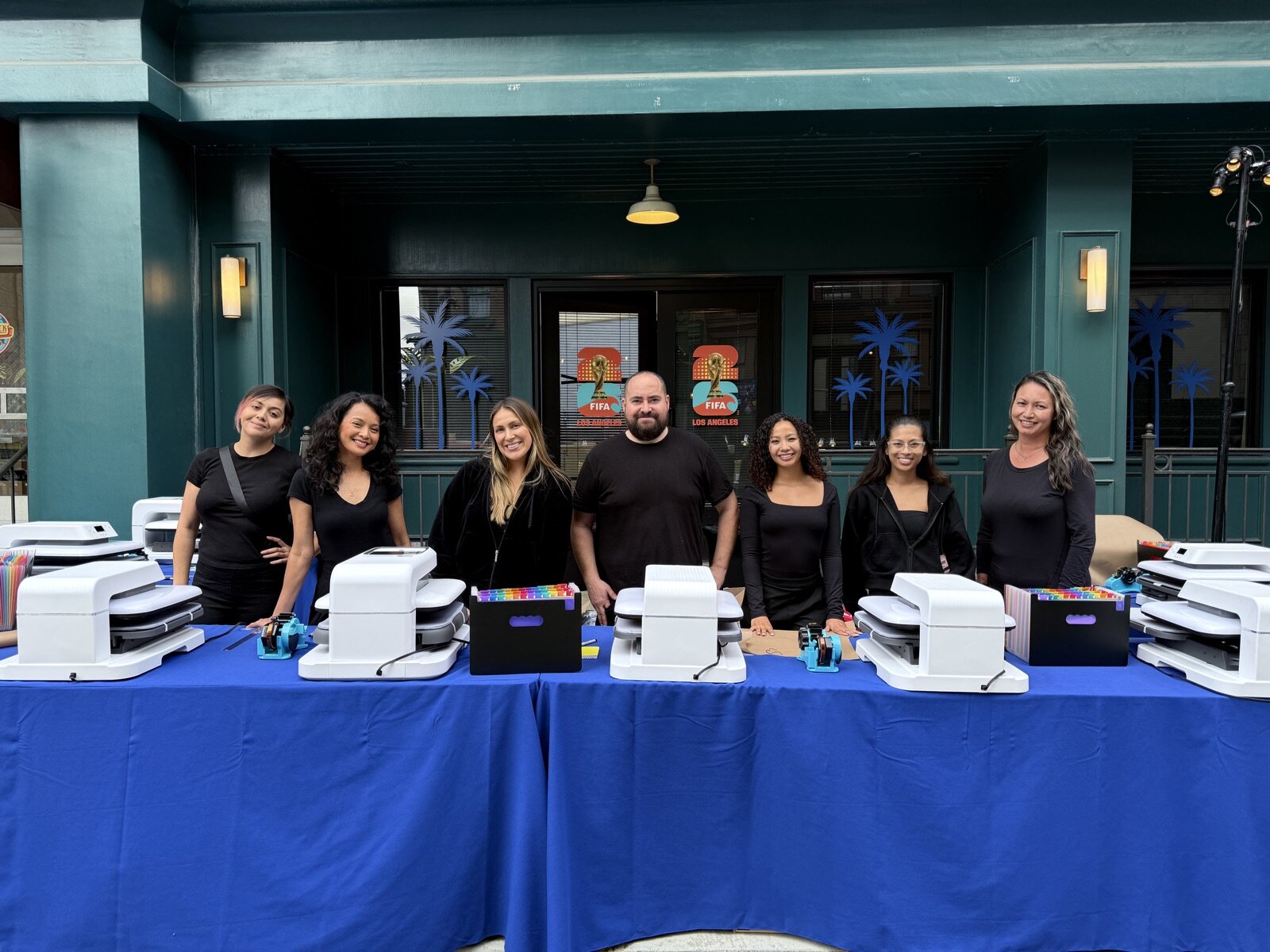
Throughput at a festival is a queue design problem before it is a production one. A single station with one long line looks impressive in photographs and converts badly. Two or three smaller stations, with separate lines for collection, personalization and payment, move far more people through the same footprint. Method assignment follows the same logic: screen for the one signature design running all weekend, DTF for the full-color and personalized work that changes daily. Staffing is $250 an hour for the first station and $125 an hour for each additional one, setup and teardown included, which is exactly why the honest trade is more stations for fewer hours, timed to the set list — the surge is predictable even when the attendance is not.
Stage sponsors, artist tie-ins and load-out
Sponsor and artist collaborations are where a festival merch budget earns itself back. A design tied to one night or one performer behaves completely differently from a generic event mark, and it gives a sponsor something guests keep instead of bin. Produce those in genuinely limited numbers and let them run out. Whatever remains at load-out should have a destination agreed before gates open — held for next year's edition, folded into the artist's own inventory, or donated locally. Local dates in Orange County, LA and San Diego carry no travel fee and a $3,000 event minimum; elsewhere it is a flat $900 travel allowance and a $4,500 minimum. Send dates, an attendance range and your site plan through the work order.