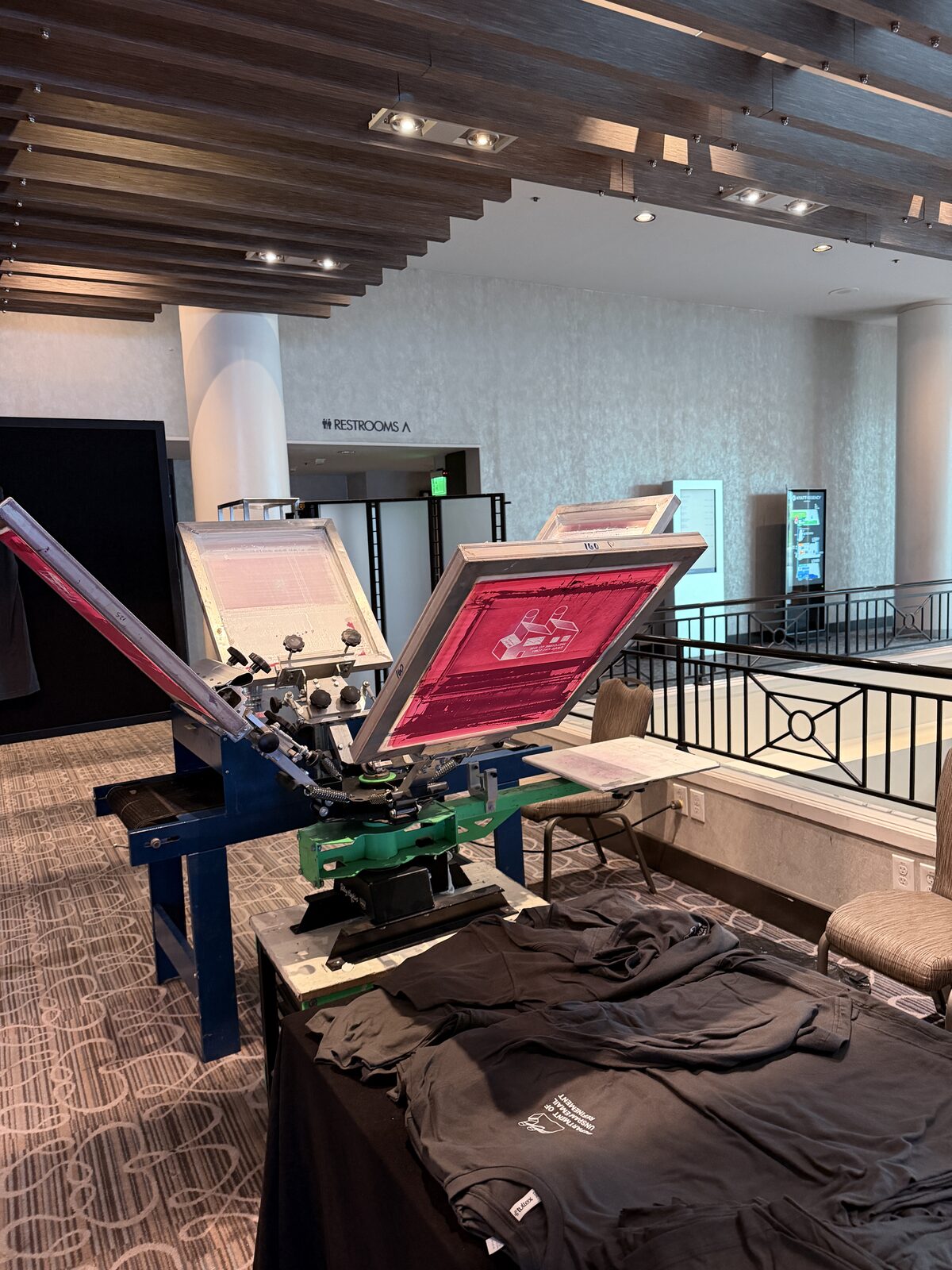
A merch budget is not a unit-price problem. It's an allocation problem: one fixed number, three competing lines, and a room full of people who will each walk out holding something or nothing. Planners who get this right decide the split before they ask what a cap costs, because the split — not the sourcing — is what makes a program feel generous or thin. Here's how to build that split, and where it quietly leaks.
Divide the number before you price anything
Cut the total into three buckets first: the goods themselves, the hours of staffed on-site production, and the logistics of getting crew and equipment to the venue. Every quote you receive is a version of those three. Pricing an embroidered cap before you know what share the goods bucket even holds is how programs end up with one beautiful item and nobody on site fast enough to hand it out.
The goods bucket: tiers, not averages
Resist dividing the goods budget by headcount and shopping at that number. An averaged program buys one mediocre thing for everyone. A tiered one buys a low-cost anchor item most attendees take, a mid item for the people who engage properly, and a short run of something genuinely good for the group you most want to remember it — speakers, sponsors, the volunteer crew. The anchor carries volume; the top tier carries the impression. Three tiers is usually enough, and the top tier rarely needs to exceed a tenth of the count.
Stations and hours compete directly with unit spend
This is the trade most budgets get wrong. Staffed production runs $250 per hour for the first station — a figure that covers setup and teardown, not just the hours guests see — and $125 per hour for each station running alongside it. Add a second station and you've bought throughput, not merch. Spend that same money on units and you've bought merch nobody can reach before the room turns over. The honest test: take the minutes between doors opening and the crowd thinning, divide the pieces you want to move by that window, and see whether one station can physically do it. If it can't, the station line grows and the unit line shrinks. That isn't the budget failing; that's the budget landing where it works.
Logistics, and the line nobody forecasts
Travel is knowable rather than mysterious: nothing added inside Orange County, Los Angeles and San Diego, and a $900 allowance for events outside those markets. Forecast it at kickoff instead of discovering it at approval. The cost that actually surprises people isn't travel — it's the second delivery, the freight on leftovers going back to an office, and the storage of whatever went unclaimed. Decide the remainder plan on day one and that line disappears; ignore it and it arrives as an invoice three weeks after everyone has moved on.
Where the money is usually wasted
Four leaks account for most of it. Over-ordering against optimistic attendance — quantities set from the invite list rather than realistic turnout, then paid for in full. Sizes bought on instinct — a curve weighted the way the organizer dresses rather than the way the room does. Decoration chosen by habit — an embroidery-shaped mark forced onto a method that can't hold it, or a full-color process bought for art that's two flat colors. Too many distinct products — five items at shallow quantities, each priced at its worst break, when three at deeper quantities would have cost less and looked more deliberate.
What to cut first when the number drops
Budgets shrink late. Cut in this order. First, the count of distinct products — collapsing five items into three recovers real money through quantity breaks and nobody perceives a loss. Second, the size of the top tier, never its quality; a short run of the good thing beats a long run of a downgraded one. Third, the anchor's spec — a lighter blank, a simpler decoration. Fourth, hours, tightening the window to the busiest stretch. Protect two things: enough stations to serve the room, and the anchor item's total quantity. Cut either and you produce the one outcome no merch budget survives — people who queued and left with nothing.
Get the split for your actual number
Allocation rules only get you to the doorway; headcount, room shape and the run of the day decide the rest. Send the date, city and expected attendance through the work order and you'll get the three buckets priced against each other, with the trade-offs named instead of buried.