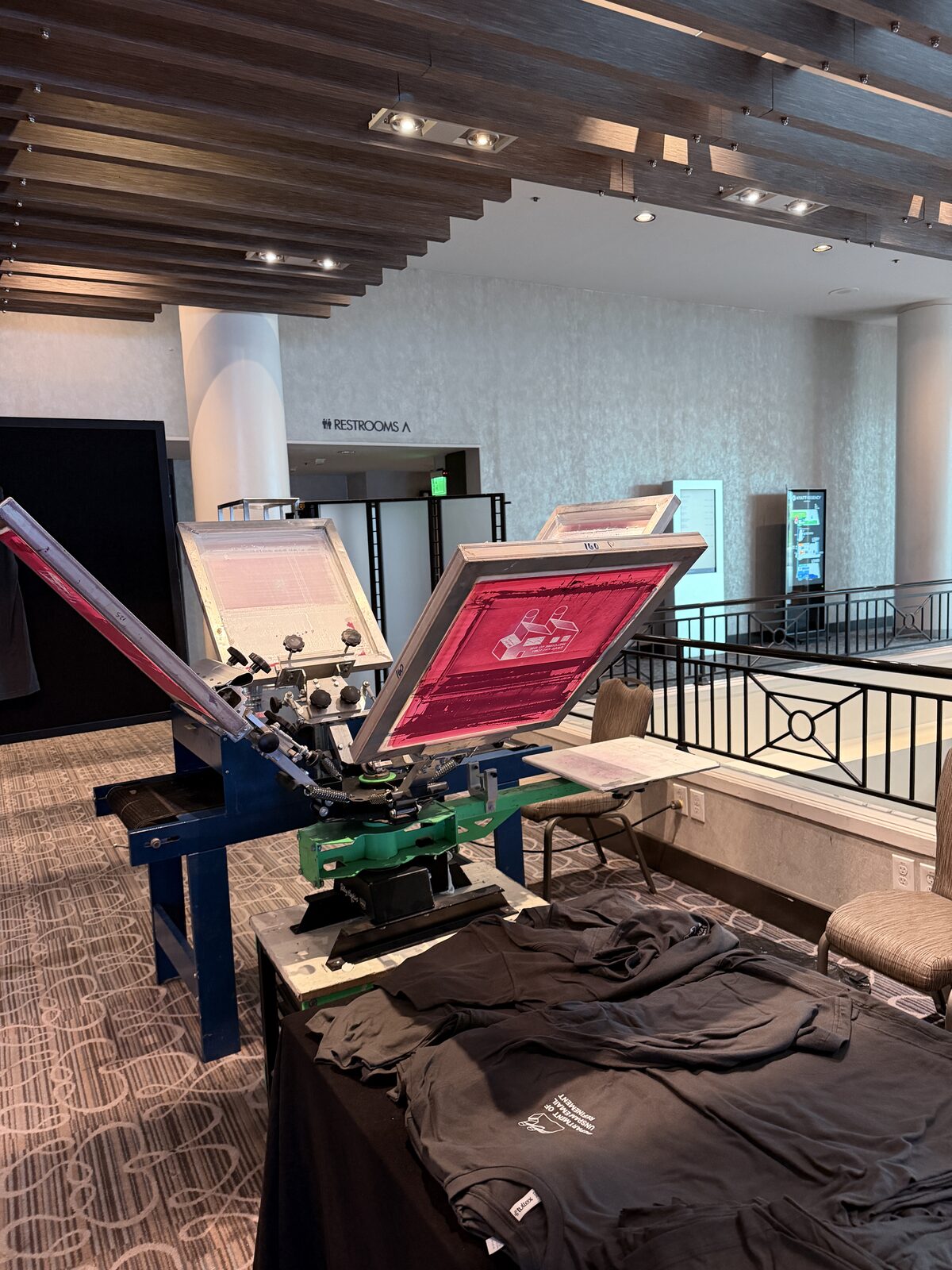
The short answer
It is one line item among several, not the program itself. A print station covers the flat, high-volume, take-home-now portion of your mix — the pieces you want made in front of guests. Everything structured, everything premium and everything that has to exist before the doors open sits on other lines: an embroidery or patch station, pre-produced VIP pieces, and a staffed handout table. The planner's real work is deciding what the station absorbs and what it does not.
What the station is actually responsible for
Draw a line down your item list. On one side sit the flat, cotton-ish, high-quantity pieces where the artwork is simple and the appeal is immediacy — these are what a print station exists to produce, and it produces them well. On the other side sit caps, outerwear, bags with structure, drinkware, and anything with a stitched or engraved mark. A print station will not touch that second column, and a program that assumes it will has an unfunded gap in it. Assign the station a scope on paper before you assign it a budget.
What it cannot cover, and what covers it instead
Three gaps come up on almost every program. Structured headwear needs a needle, which means a second station and a second operator, not an add-on to the first. Executive and VIP pieces are usually too few and too finished to make on site, so they get produced ahead and handed over rather than queued for. And speaker, sponsor or partner gifts almost always need to be in hand before the room opens, which puts them outside the live window entirely. Each of those is a separate line with its own lead time.
What it does to the floor plan
Adding a station is a spatial decision as much as a merchandising one. A station generates a queue, and a queue is the thing that actually consumes your room — it wants somewhere it can stack up without severing a circulation path or blocking a bar. Put it on an edge or in a corner with open floor in front of it, near a power drop, on a route a cart can reach from the dock. Producers who place it centrally for visibility usually end up moving it, because a line across the middle of a room reads as congestion rather than as an attraction.
The handoffs a planner owns
Four handoffs decide whether the station runs cleanly. Artwork has to be locked and approved far enough ahead that production is not improvising. Item and quantity per line have to be committed, because the station is built around them. The live window has to be agreed with whoever owns the run of show, so the station is not open during a seated dinner or closed during the only free hour. And somebody has to own the finished goods — who bags them, who holds them, what happens to the pieces nobody claims.
When it should not be the anchor
If your mix is weighted toward caps, fleece, bags or gifting, the print station is a supporting act and should be budgeted as one. Anchor the program on the station that makes the majority of your items, then let printing carry the volume line behind it. The failure mode we see most is a program built around the station that is easiest to picture rather than the station that produces most of what the guest list actually wants to take home.